© Maryline Jacques
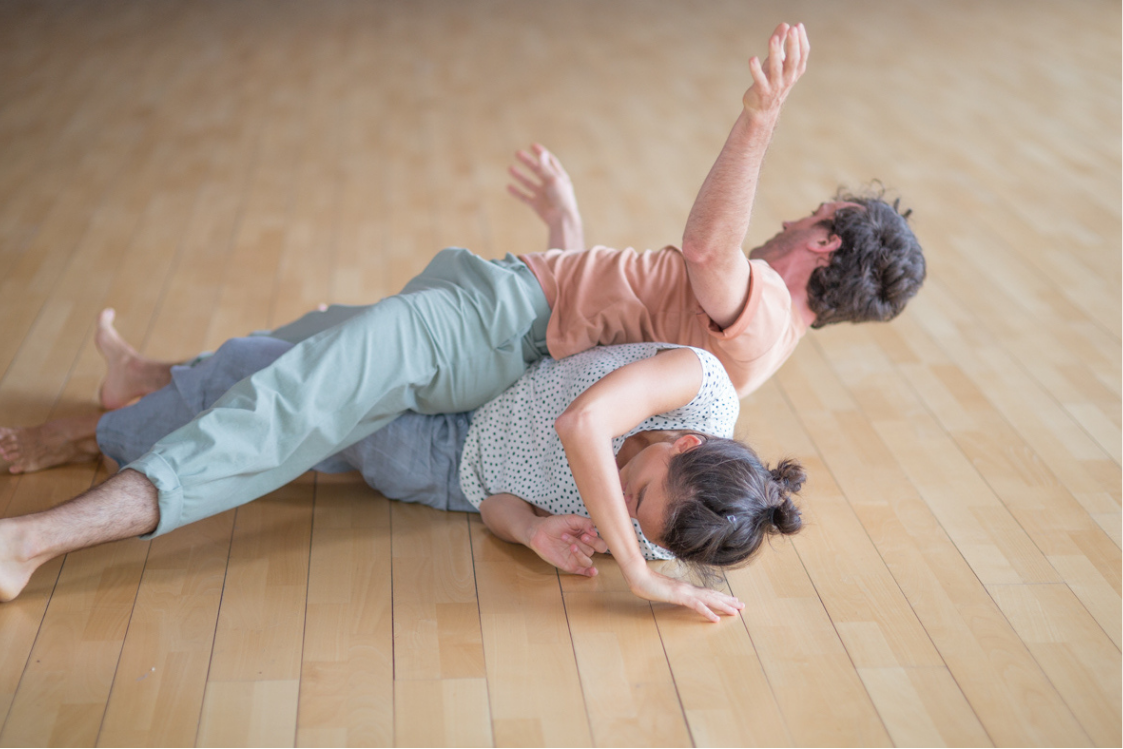
The contact improvisation we propose to practice together is a collective artistic practice involving embodied, attentional and relational skills.
Practice spaces provide opportunities to learn, invent and share. Playing with gravity, sharing weight and physical contact can sometimes bring us up against our limits, give rise to delicate situations or reveal certain vulnerabilities, including among experienced participants. But it also opens up the possibility of collectively inventing other forms of attention and shared responsibility, and of making our practices spaces for individual and collective transformation.
This text aims to support the co-creation of spaces for exploration and improvisation where everyone can gradually develop their creativity, attention, communication, capacity for adjustment and sense of consent, within a joyful, stimulating and respectful practice environment.
1. Taking care of ourselves and others
- I take care of myself, others and the shared space, taking into account my own possibilities at any given moment as well as those of my partners.
- I favour attentive, reciprocal contact that serves the dance.
- I respect the frameworks and guidelines established by the facilitators.
- Contact improvisation involves a gradual learning process that requires time and guided practice.
- Jams and laboratories are spaces for improvisation and experimentation intended for people who already have some experience of the practice and sufficient familiarity with its issues to participate autonomously.
2. Cultivating consent
- Consent is at the heart of the practice and can change at any time.
- Everyone is free to accept, refuse or interrupt an interaction, without having to justify themselves.
- The absence of an explicit refusal does not constitute consent.
- I pay attention to signs of comfort as well as discomfort, both in myself and in others.
- When in doubt, I favour explicit verbal communication.
- Any form of violence, harassment or sexualised behaviour is incompatible with this space.
- If a situation concerns me, I inform the organising team.
This attention to consent sometimes requires courage, effort and perseverance. It is developed through practice, and we aim to support one another in this process.
3. Engaging in dialogue
- I endeavour to communicate my needs, limits and feelings clearly and respectfully.
- When a difficulty arises, I favour dialogue with the people concerned or, if necessary, with the association’s designated contacts.
- I welcome what others have to say and their lived experience without minimising or disputing it, even when their perception differs from my own.
- I agree to take part in a period of dialogue with the people responsible for the practice framework if they consider it necessary.
4. Contributing to a welcoming practice space
- During times of shared reflection and experience, I take care to speak from my own experience, recognising that it is situated and does not constitute a general truth.
- I contribute to a practice that is open to everyone, regardless of gender, age, background, culture or level of experience.
- I participate in the association’s activities in a spirit of cooperation, learning, sharing and curiosity, while respecting each person’s individuality.
- If behaviours that are incompatible with this charter continue despite a period of dialogue with the people responsible, the association may take the necessary measures, which may include temporary or permanent exclusion.
5. Limits, perception and relationships in practice
The following section offers some elements for understanding what can sometimes make the perception and expression of limits difficult.
Our bodies are situated within social and relational contexts: gender, age, social background, able-bodiedness or disability, status within the group, experience of the practice, … These factors influence whether or not we may feel entitled to say “no”, slow down, stop or leave a situation. These dynamics are not simply matters of individual decisions. They often collectively and systemically, and frequently unconsciously, shape our perception of what is legitimate, sayable or hearable.
Added to this are more situational and changing dimensions: fatigue, emotional overload, personal history stirred up by the practice, disorientation, the desire to please, the need to belong, or physical differences. These can also, sometimes very subtly, influence our very ability to perceive a limit — in ourselves or in another person — to express it and to respect it.
Taking these different issues into account invites us not to expect everyone to be able to perceive and express their limits regardless of the context. In order to foster conditions that allow everyone to choose their level of engagement and adjust it at any time, we invite ourselves to cultivate a practice environment that makes room for not knowing, for saying no, for changing one’s mind, for remaining attentive to subtle signals, and for recognising our own points of vulnerability, without having to deny or conceal them.
Text written by Catherine Kych
with the thoughtful perspectives of Myriam Suchet and Astrid Le Jeune